


Basics of baga
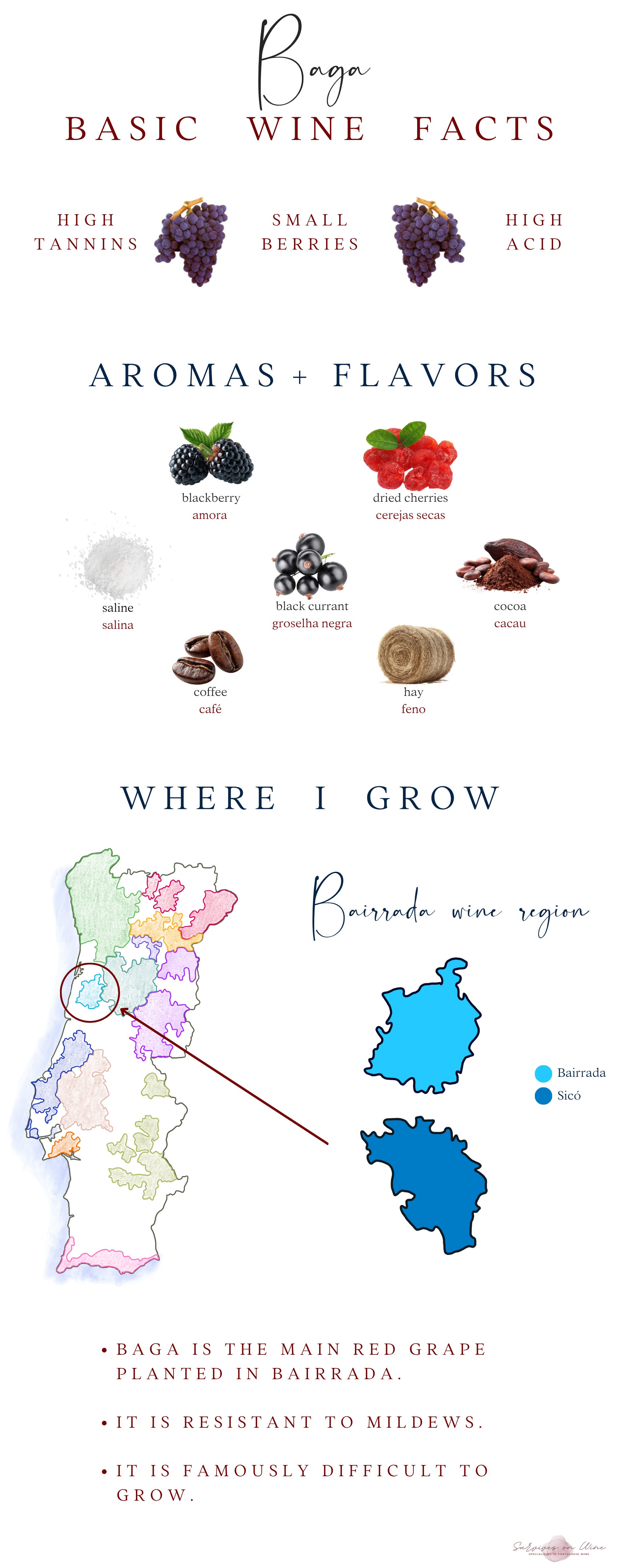
Baga is one of Portugal’s most interesting red grapes and definitely one of its most misunderstood. It’s mostly grown in the Bairrada region in central Portugal, but you’ll also find it in neighboring regions, Dão and Beira Interior. The word baga means berry in Portuguese. As baga grows in small, tightly packed bunches of berries, it perfectly fits the name.
Baga has a bit of a stubborn streak and is a little high maintenance. It’s a late-ripening grape with small, tightly packed clusters that can be challenging to grow and to work with. You may have heard some less-than-flattering things about Baga in the past. Super acidic, rough tannins, funky wines, or wines that felt flat. Let’s put those ideas out of your mind forever. Winemakers growing baga today are doing some really beautiful things. The days of below average baga wines are over. Baga today is often made in two different styles, the more traditional style and the newer modern approach. Traditional baga tends to be deeply colored, concentrated, and packed with tannins. The newer style is lighter and fresher, with softer tannins, bright fruit, spice, and a little more approachability for the average drinker.
I think there is absolutely room for both styles. But if I had to guess, I’d say baga’s future on the world stage may lean more toward these fresher, modern expressions that make people fall in love with the grape a little faster.
Baga is not just used for red wines. You’ll also find it in rosés and some of Portugal’s most respected sparkling wines thanks to its naturally bright acidity. Industry estimates suggest around 20 to 30% of baga grapes may go into sparkling wine production, although hard numbers are surprisingly difficult to track down. Sparkling wines in this region are fantastic. They are crisp, very refreshing when young and age gracefully developing toast notes and lots of complexity.
Baga thrives in clay-rich soils, often with limestone mixed in, giving the wines structure, freshness, and the backbone that allows many of them to age for years. Bairrada region provides ample amounts of the perfect soil for it to thrive. But because of this, baga is a vigorous growing grape. Proper canopy management needs to take place, like manual thinning, to ensure airflow to the canopy as well as to let sunlight to get in. It also produces high yields, which sound great, but is not actually great. The grapes need to be cluster thinned or cordon trained to reduce the yields which then help maintain concentration of the juice.
Baga is resistant to mildews, which is really good as it grows so well by the coast. However, it can be susceptible to botrytis later in the season if it rains at harvest time. Botrytis is grey rot, not good at all. A lot of time, producers will avoid this possibility by harvesting baga early and using the grapes for sparkling wine production instead of still wine.
As of 2024, it accounts for 4% of the countries planted vineyard area, nearly 8,000 hectares and approximately 2,500 growers. Mateus rosé produces roughly 20 million bottles of their rosé a year. 60% of their blend is baga. That is give or take 9,000 tons of baga grapes per year. Let that sink in! So, if you think you haven’t tried baga, you probably have if you ever tried the famous Mateus rosé.
Luís Pato and his contribution to the baga grape
I feel I can’t write about baga without mentioning Luís Pato. When many growers in Bairrada were replacing baga vines with other varieties, Pato did the opposite and invested in the grape, believing in its potential.
In the early 1980s, Pato started making wine under his own name, focusing on learning more about baga in both the vineyard and the cellar. He introduced new practices like green harvesting to reduce yields, destemming to soften the tannins, and temperature-controlled fermentation. These changes showed a new side of baga that many wine drinkers hadn’t seen before.
At the time, many people thought of baga as rough and hard to work with, but Pato proved it could produce elegant, age-worthy wines with freshness, structure, and character. His work changed people’s perception of the grape and helped bring attention to both baga and the Bairrada region. To this day he is still making the grape shine in his vineyard. But his legacy doesn’t stop there. His daughter, Filipa Pato is also bringing baga wines into the future.

We live about 3 hour's drive north of Bairrada and try and visit at least one a year. We're really impressed with the sparkling wines based on Baga which we find much more destinctive and harmonious than sparklers made from other varieties there. So much so that I'd much rather drink a €10 sparkling Baga from Bairrada then a €12-14 Cava.
And Prosecco can **** right off.
I like Pato’s Baga Rebel. Though ageworthy, it’s meant to be consumed young. I find it approachable and wonderfully aromatic. Filipa seems to take a more elegant style reminiscent of a quality Burgundian style. A great entry level, I think, is Niepoort Lagar de Baixo. Usually I can find it around $25 which is an amazing value for the quality. Thank you for this great post! Portugal doesn’t get nearly the credit it deserves for its wine🇵🇹Kudos for this comprehensive look at Baga.